Water hardness, iron, and manganese: what they mean and when they are a problem
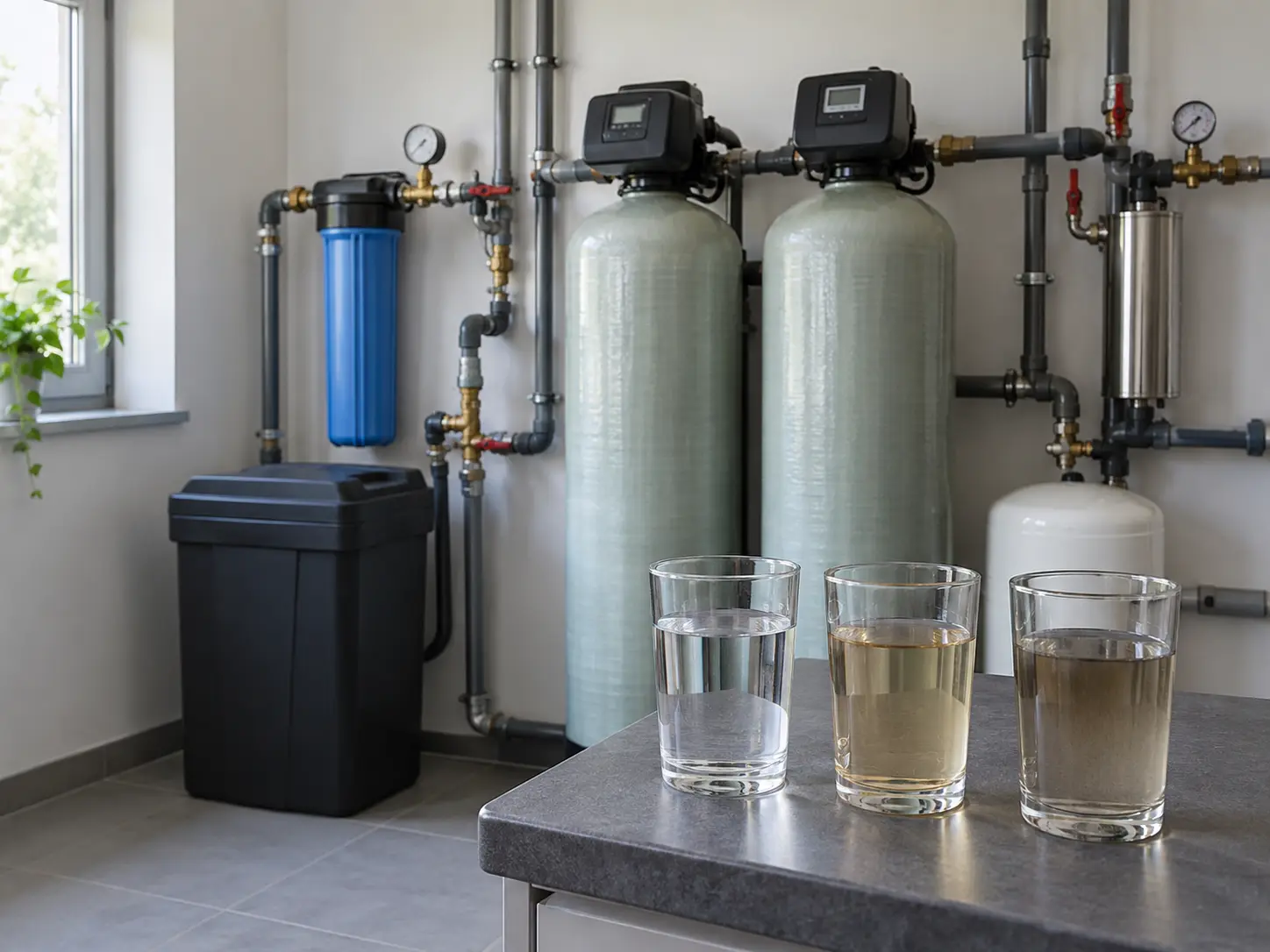
Water hardness, iron, and manganese are often mentioned together, but they are not the same issue. Hardness is primarily related to the content of calcium and magnesium, while iron and manganese can affect the color of the water, the formation of deposits, taste, and the operation of plumbing and appliances.
The appearance of water alone is not sufficient for reliable diagnosis. Clear water may contain dissolved iron or manganese, and the hardness level says nothing about the microbiological safety of the water.
For well water, the correct first step is to conduct a current analysis of the raw water. For water from a public water supply, one can initially rely on the supplier's data or on hardness measurements when addressing hardness issues.
Hardness, iron, and manganese are not the same problem
| Indicator | What does it represent | Typical manifestation | What needs to be determined |
| Water hardness | especially the content of calcium and magnesium | hard water deposits, coatings on faucets and appliances | hardness, water consumption, required flow rate, and treatment goal |
| Iron | iron naturally present in water or released from distribution materials | yellow, orange to brown coloring and deposits | concentration, form of iron, pH, and related indicators |
| Manganese | an organism naturally present mainly in certain groundwater | dark to black deposits or stains | concentration, pH, form of manganese, and conditions in the water |
The same visible symptom can have multiple causes. Brown water, for example, may not automatically mean just increased iron, and water without visible discoloration may not be free of iron or manganese.
What does water hardness mean
The hardness of water is primarily caused by dissolved compounds of calcium and magnesium. Their content mainly depends on the geological substrate and the types of rocks that the water passes through.
In households, hard water is primarily manifested by the formation of limescale. This is more significantly created where water is heated or evaporated – for example, in water heaters, electric kettles, washing machines, dishwashers, on faucets, or shower enclosures.
Hardness is therefore primarily an operational and comfort issue. However, the hardness value alone is not sufficient to assess whether the water as a whole is suitable for drinking.
The Slovak regulation of the Ministry of Health of the Slovak Republic No. 91/2023 Z. z. states that the recommended range for the sum of calcium and magnesium is 1.1 to 5.0 mmol/l. This is a recommended value, not the highest limit value, the exceeding of which would in itself mean that the water is not potable.
When treating water, the automatic goal should not be "the softest water possible." The appropriate setting depends on the source water, the purpose of treatment, and the specific system.
How does iron manifest in water
Iron naturally occurs mainly in groundwater. However, it can also enter the water from metal parts of the distribution systems.
Iron can be dissolved in groundwater, and freshly pumped water may appear clear at first glance. Upon contact with air, some of the iron oxidizes, and yellow, orange, or brown coloring or sediment may appear.
Typical manifestations include:
- rusty and brown stains on sanitary ceramics,
- coloration of water after standing,
- deposits in pipes or equipment,
- deterioration of the sensory properties of water.
The Regulation of the Ministry of Health of the Slovak Republic No. 91/2023 establishes a limit value of 0.2 mg/l for iron in drinking water. In cases of naturally elevated iron content in groundwater, the regulation allows for a higher value of 0.5 mg/l under specified conditions, provided that the sensory properties of the drinking water are not affected.
Increased iron cannot be assessed solely based on whether the water looks acceptable. When it comes to well water, the results should be evaluated alongside other indicators from the analysis.
How does manganese manifest in water
Manganese, like iron, occurs naturally in rocks and groundwater. Its increased content may not manifest immediately.
Oxidized manganese compounds can create dark brown to black deposits on sanitary ware, fixtures, laundry, or in the internal parts of plumbing. However, dissolved manganese may remain visually inconspicuous in water.
The Slovak legal regulation sets a limit value for manganese at 50 µg/l, which is 0.05 mg/l. In areas with naturally high concentrations of manganese in groundwater, a value of 100 µg/l, or 0.1 mg/l, may be applied under conditions specified by the decree, provided that the sensory properties of the water are not affected.
When it comes to manganese, it is necessary to distinguish the Slovak legal limit from the health recommendation of the World Health Organization. In its current Guidelines for Drinking-water Quality from June 2026, WHO states a preliminary health-based guideline value for total manganese of 0.08 mg/l. WHO also emphasizes that when setting requirements for manganese, both health and sensory aspects should be considered.
The WHO guideline value is not a legal limit in Slovakia. It is a professional health guideline that should be interpreted separately from national legislation.
Why clear water is not enough as proof of quality
The appearance, taste, and smell of water are useful signals, but they do not replace measurement.
Dissolved iron or manganese may be present in water even before visible coloration or sediment appears. Similarly, water without iron and manganese may be unsuitable in a completely different chemical or microbiological parameter.
Therefore, it applies:
A symptom may indicate a problem, but its cause needs to be confirmed through measurement or analysis.
When it comes to well water, it is also important to know where the sample was taken. The result of raw water before treatment and the result of water after the existing system answer two different questions.
Why it's not enough to choose a technology based on a single number
Hardness, iron, and manganese are not automatically adjusted in the same way. Even the concentration of a single indicator may not be sufficient for selecting the appropriate equipment.
When designing water treatment, the following factors may be crucial:
- water source,
- current analysis,
- pH,
- concentration of iron and manganese,
- overall hardness,
- other related indicators,
- peak flow,
- daily water consumption,
- required quality of treated water,
- available pressure,
- conditions for installation and wastewater drainage.
When it comes to well water, this check is particularly important. Equipment selected solely based on hardness may not be suitable if the water simultaneously contains iron, manganese, or other substances that affect the technology's function.
Danum therefore bases its design for the treatment of well water on analysis, consumption, required flow rate, and the technical conditions of the facility.
When it is mainly about comfort and when it is about the quality of drinking water
In hard water, the main reasons for treatment are the protection of appliances, the reduction of limescale formation, and comfort in using water.
When it comes to iron and manganese, the results should also be compared with the requirements for drinking water quality. However, even acceptable values for these three indicators do not confirm that the water meets all other chemical and microbiological parameters.
Therefore, it is not correct to say:
“The water is fine because the iron and manganese are acceptable.”
It is also not correct to automatically consider hard water to be health hazardous just because it creates limescale.
What to do before choosing water treatment
If you use well water, rely on the current analysis of raw water. If you already have a water treatment system and need to verify its function, it may be necessary to compare the water before and after the device.
If you use water from the public water supply and are primarily concerned with hardness and limescale, the basic information is the hardness of the water. In the case of unusual coloring, odor, or other issues at a specific sampling point, it may be appropriate to check the water directly at the location.
Only then does it make sense to decide on the technology.
With hard water, it can be a suitable solution ion-exchange softening. For iron and manganese, the treatment method is chosen based on their concentration, form, pH, flow rate, and other properties of the water..
The first step is not to choose a filter, but to find out what is actually in the water.
Danum s.r.o.