What residual hardness should be set after water softening?
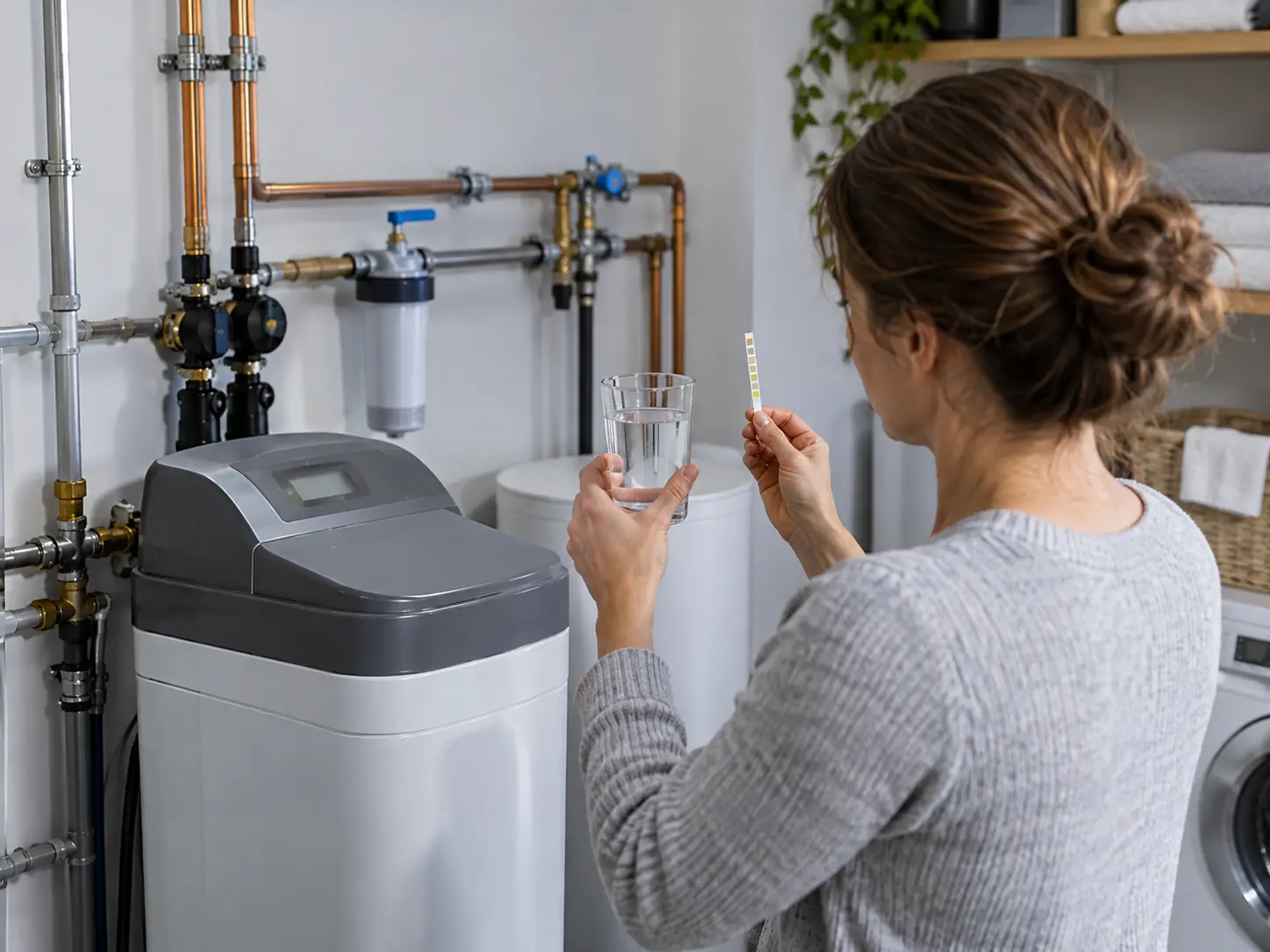
After water softening, there is no single universal hardness value that is correct for every household. The appropriate setting depends on the incoming water, the purpose of its use, the requirements of appliances, and whether the treated water is also used for drinking.
Therefore, it is not correct to adopt a recommendation like "set the softener to 5 °dH" without further information. The same number can mean different resulting water quality in two households.
What does residual hardness of water mean
The ion-exchange softener removes mainly calcium and magnesium ions from water, which make up most of its hardness. In a standard sodium ion-exchanger, these ions are exchanged for sodium.
The water coming directly from a properly functioning water softener can therefore have very low hardness. However, in a household, the resulting water can also be adjusted by mixing completely softened water with a portion of untreated water.
The resulting hardness after such a setting is often referred to as residual hardness.
Not every softener has the same method of mixing and setting. Therefore, the specific procedure should be verified according to the design and documentation of the given device.
Why there is no single ideal value
Water hardness is not a standalone parameter by which the overall quality of water can be assessed.
When setting up the softener, it is essential to consider:
- hardness of the incoming water,
- content of calcium and magnesium,
- purpose of water,
- requirements of devices connected to the distribution,
- method of mixing treated and untreated water,
- other chemical properties of water,
- in drinking water also the change in its composition after ion-exchange softening.
Different conditions may apply to a family house where water is used for drinking and hygiene, and different ones for example technology, steam appliances, or operations with a precisely defined required water quality.
Zero hardness is not automatically a goal
From a technical perspective, very low hardness may be desirable in certain applications. However, this does not imply that household drinking water should always be adjusted as close to 0 °dH as possible.
The Slovak legislation regarding drinking water specifies recommended values for calcium, magnesium, and their combined content. The Regulation of the Ministry of Health of the Slovak Republic No. 91/2023 Coll. states that the recommended calcium content is above 30 mg/l, magnesium is between 10 and 30 mg/l, and the sum of calcium and magnesium is between 1.1 and 5.0 mmol/l. These are recommended values, not a universal directive to set the water softener to a specific number of hardness degrees.
The Public Health Authority of the Slovak Republic also provides these values regarding the hardness of drinking water in relation to the content of calcium and magnesium.
If the water is to be used as drinking water after softening, it is not enough to mechanically monitor only the value in °dH.
Hardness and the content of calcium or magnesium are not exactly the same
A home hardness test usually informs about the overall hardness of the water. However, it does not separately indicate how much calcium and how much magnesium is in the water.
Two waters with similar overall hardness can have different ratios of these minerals. After ion-exchange softening, the ionic composition of the water also changes.
For a preliminary setup of the household, measuring hardness can be practical. However, if you need to assess the specific chemical composition of drinking water, a laboratory analysis is more appropriate.
The corrosiveness of water cannot be determined solely by its hardness.
A common mistake is the assertion that water below a certain hardness is automatically "aggressive" or corrosive.
This conclusion is too simplistic.
The corrosive properties of water are influenced by several factors including pH, alkalinity, dissolved substances, temperature, the material of the distribution system, and other chemical conditions.
The measurement result of hardness alone is therefore insufficient to assess the corrosiveness of water or the suitability of a specific setting for the entire distribution system.
How to practically set residual hardness
The correct procedure does not start with a specific number, but with the input data.
1. Determine the hardness of the incoming water
Before setting the water softener, it is necessary to know the actual hardness of the water before the device.
A drop test can be used for preliminary checks. When a more precise assessment is needed or when dealing with well water, it is advisable to rely on the current water analysis.
2. Determine what the treated water is used for
Decide whether it is:
- the whole house including drinking water,
- protection of appliances and wiring,
- specific technical device,
- technological process.
The required water quality can vary significantly depending on the purpose.
3. Set the mixing according to the specific device
If the softener or its connection allows for regulated mixing of untreated water, the resulting hardness is adjusted in this way.
The settings should not be done blindly. After each change, the result needs to be measured accurately.
4. Measure water for the softener
The measurement should be performed on water that already corresponds to the result used in the household.
In a mixing system, it is therefore not only the water directly behind the ion exchange resin that is decisive, but also the resulting water after mixing.
5. Verify the settings during normal operation
One measurement immediately after the setting change may not capture all operating conditions.
After adjusting the settings, it is advisable to verify the result again and monitor whether the hardness changes significantly during operation or after the device has been regenerated.
What if we also use water for drinking?
In that case, it is advisable to look broader than just at limescale.
The Slovak requirements for drinking water operate independently with the content of calcium, magnesium, and their sum. Therefore, it is not accurate to equate a specific value in °dH with automatically "ideal drinking water."
In its current guidelines for drinking water quality from 2026, WHO also approaches drinking water quality as a set of health, chemical, and operational factors, rather than as a single target value for hardness.
In the case of significant treatment of water intended for regular drinking, it may make sense to check not only the total hardness but also, depending on the situation, its resulting mineral composition.
When it comes to boilers and technologies, follow the requirements of the equipment
The situation is different if softened water supplies a system with precisely defined requirements for the input water.
It can be, for example a:
- boiler,
- steam device,
- washing technology,
- gastronomy operation,
- industrial process.
At that time, the general domestic recommendation does not take precedence over the manufacturer's requirements or the project documentation.
If the manufacturer specifies the maximum hardness, conductivity, or any other qualitative condition of the input water, it is necessary to refer to the documentation of the specific model.
Most Common Mistakes When Setting Up a Water Softener
Setting according to the number found on the internet
The value suitable for another household may not be suitable for your water.
Effort to always bring hardness to zero
Very low hardness may be a technical goal for a specific application, but it is not automatically a goal for every household drinking water.
Control only before the softener
For the setup, you also need to know the result behind the device.
Confusing hardness with overall water quality
The softener addresses hardness. It does not confirm the microbiological or overall chemical quality of the water by itself.
When it comes to well water, it is not enough to know just the hardness.
Setting without subsequent measurement
The position of the mixing valve or the information in the device menu is not a substitute for a control measurement of the resulting water.
What value is therefore correct?
The correct answer is not a single number.
The appropriate residual hardness is one that meets a specific treatment purpose while also respecting the composition of the water, the manner of its use, and the requirements of connected devices.
For the household, this approach is therefore more sensible:
measure input water → determine treatment goal → set the device → measure output water → adjust settings as needed.
When it comes to well water or unusual chemical composition, it is advisable to rely on the current analysis and not to assess softening based solely on one hardness number.
Danum s.r.o.