What is hard water in practice?
Hard water contains higher amounts of dissolved calcium and magnesium. In households, it is primarily manifested by deposits of limescale in places where water is heated or evaporates, and by increased consumption of soap or detergents. However, hardness alone does not indicate whether the water is safe to drink – other chemical and microbiological indicators must also be assessed.
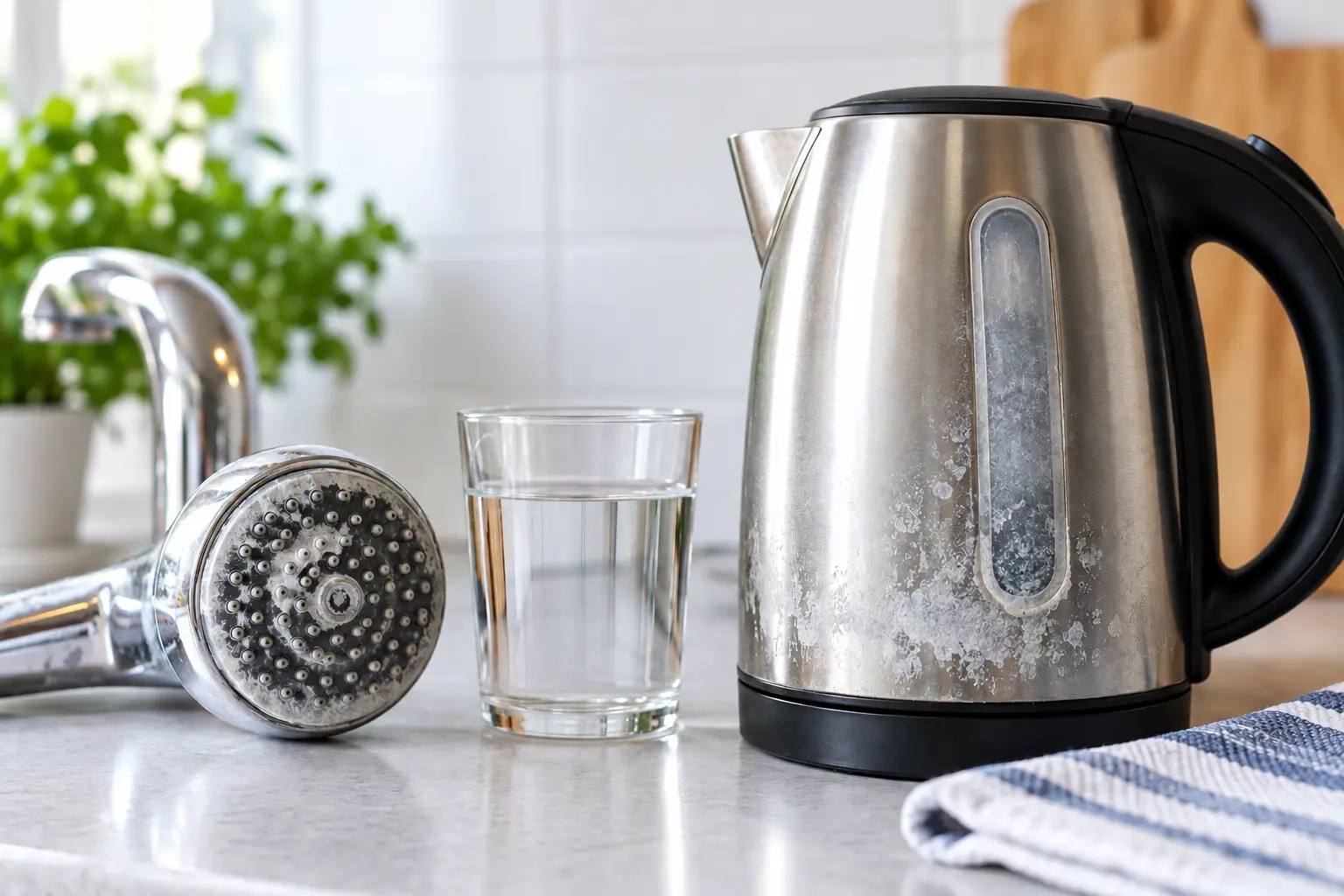
Therefore, it is not enough to see a white coating on the kettle when deciding on water treatment. The first step is to determine the actual hardness of the water and assess what specifically causes it in the household.
What does water hardness mean
Water hardness is primarily related to the concentration of dissolved ions of calcium and magnesium. These ions enter the water naturally through contact with rocks and soil.
Therefore, water from different sources can have significantly different hardness. Differences arise between regions, as well as between individual wells or water sources.
Hardness is not the same as turbidity, iron, manganese, or microbiological contamination. Water can be completely clear and still very hard. Similarly, water with a brown color or unpleasant odor may not primarily have hardness as an issue.
How is water hardness expressed
In Slovakia, water hardness is often expressed in mmol/l or in German hardness degrees °dH.
It is approximately valid:
1 mmol/l ≈ 5.6 °dH
The higher the value, the more substances that cause hardness the water contains. However, the number itself does not yet determine whether the household needs a softener. It is also important what the water is used for, at what temperature it is operated, and what technical problems it causes..
The Slovak Regulation No. 91/2023 Z. z. states that the recommended value for the sum of calcium and magnesium is 1.1 to 5.0 mmol/l. This is a recommended value (OH), not the maximum limit value for contaminants. The regulation separately specifies the recommended values for magnesium as 10 to 30 mg/l and for calcium as above 30 mg/l.
This is an important distinction: the hardness value is not in itself evidence that the water is or is not health safe.
How hard water manifests in the household
The most well-known manifestation of hard water is limescale.
It can typically be observed:
- on the electric kettle and coffee maker,
- on showerheads and faucets,
- on glass and ceramics after the drops have dried,
- in water heaters and on heating appliances,
- in devices where water is repeatedly heated or evaporated.
When heating and changing the chemical balance of water, substances related to hardness can create mineral deposits. However, their formation does not depend solely on one hardness value. Temperature, alkalinity, pH, water composition, and operating conditions also play a role.
Harder water also reduces the effectiveness of soap in producing lather. The WHO cites soap consumption and the formation of deposits as typical practical consequences of water hardness.
Hard water does not automatically mean undrinkable water
The white coating in the kettle may indicate higher hardness, but it does not reliably indicate the presence of bacteria, nitrates, pesticides, heavy metals, or other substances.
It works the other way around as well. Soft water is not automatically safe to drink.
If you need to assess the overall quality of well water, a hardness test alone is not sufficient. The necessary scope of analysis depends on the water source, the method of use, and what risks need to be evaluated.
Is hard water a health problem?
WHO does not set a health-based guideline value for water hardness itself. Therefore, hardness should not be interpreted in the same way as indicators for which a health-based maximum concentration is established. WHO also emphasizes that calcium and magnesium in water should be assessed in a broader context of drinking water quality and acceptability.
In Slovakia, calcium, magnesium, and their sum are classified as indicators with recommended values in Regulation No. 91/2023 Coll. Therefore, one hardness value cannot be used to conclude that the water as a whole meets all the requirements for drinking water.
If you are dealing with a specific health condition or individual dietary restriction, a general assessment of water hardness does not replace the advice of a healthcare professional.
How to determine water hardness
For water from a public water supply, the first source of data may be the water supplier. However, the value may vary depending on the specific serviced area and source.
Hardness can also be measured directly. For preliminary home measurements, test strips or drop titration tests are commonly used. If you need an accurate reading as part of a broader water assessment, a laboratory analysis is suitable.
The conductivity meter or TDS meter does not measure hardness directly. It detects another property of water, and without additional data, it is not possible to reliably calculate the concentration of calcium and magnesium from it.
When it comes to well water, this difference is particularly important. If a device for water treatment is to be proposed based on the results, other relevant indicators must also be known.
When does it make sense to address hardness
There is no single universal value above which every household needs a water softener.
The decision depends mainly on:
- measured hardness of water,
- amount and nature of deposits,
- the temperature to which the water is heated,
- types of heaters and appliances,
- desired comfort while showering and cleaning,
- consumption and required flow,
- source of water and its further chemical composition.
For water from a public water supply, hardness can be a key parameter for addressing limescale. However, for well water, the technology should not be chosen solely based on hardness. Iron, manganese, pH, turbidity, or other parameters can significantly affect the suitability of the design.
What does water softening change
Classic ion-exchange softening reduces the concentration of calcium and magnesium ions that contribute to water hardness. As a result, there is a lower tendency for the formation of deposits related to hardness.
However, a water softener is not a universal filter for all water problems. Softening alone does not automatically address microbiological contamination, nitrates, turbidity, odor, or all the issues typical of well water.
The capacity of the device and the method of its adjustment therefore depend on the specific input water, consumption, desired flow rate, and target water quality.
What to do first
If you are troubled by limescale, do not start by choosing a device. First, determine the actual hardness of the water.
In a public water supply, the data may be available from the water supplier or it can be measured. For a well, it is advisable to know other relevant water parameters before designing treatment.
Only then can it be reasonably assessed whether regular maintenance of appliances is sufficient, whether only a specific branch needs adjustment, or if central water softening is necessary.
Editorial Office Danum s.r.o