What makes sense to modify for drinking and what doesn't
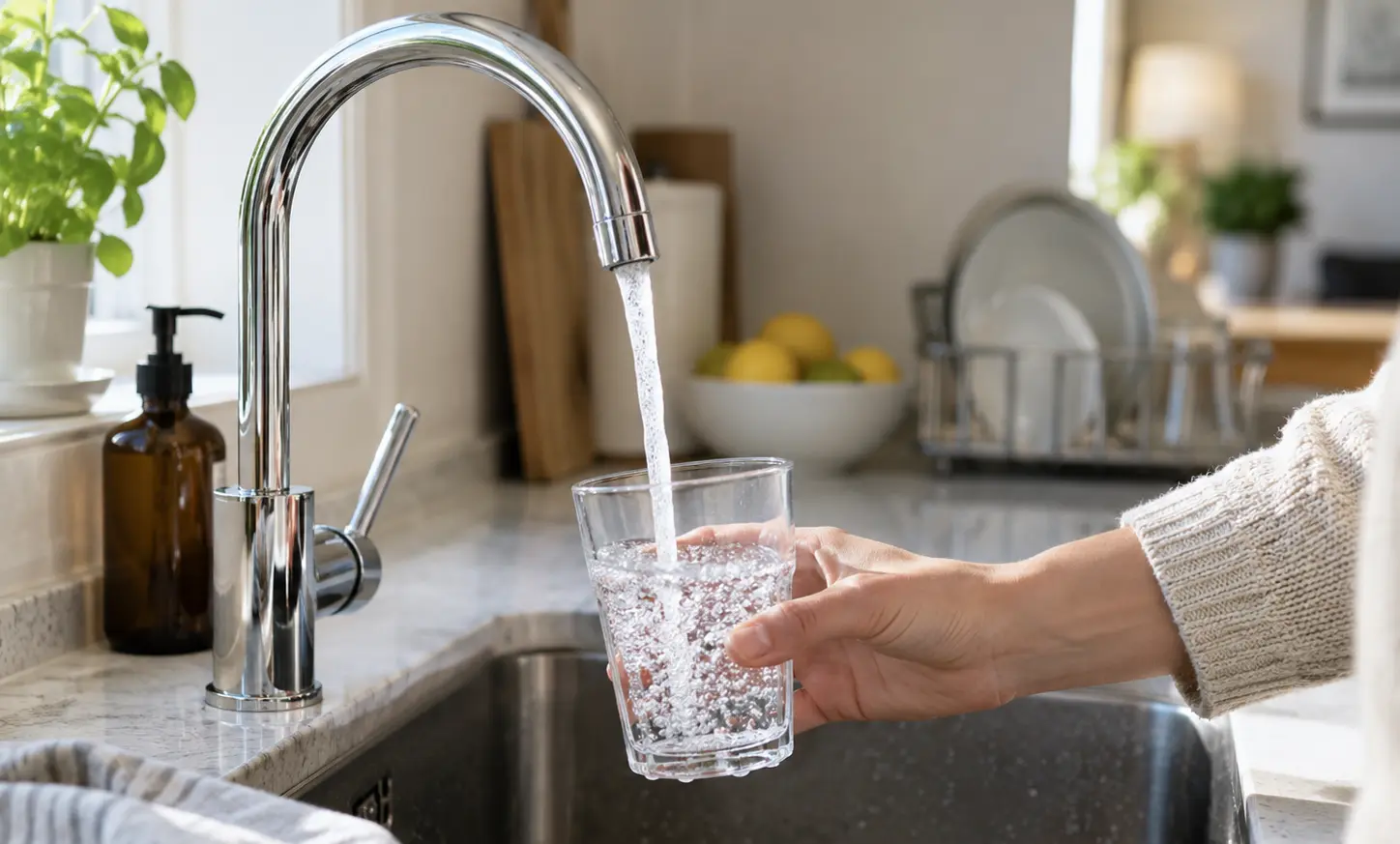
Not every water needs to be automatically treated further. The correct procedure depends on the water source, its current quality, the problem you want to solve, and whether you need treated water only for drinking and cooking or throughout the entire house.
For well water, the basis is a current analysis. For water from a public water supply, it makes sense to first identify the specific reason for treatment – for example, taste, odor, hardness, or a requirement for a certain property of the water. Only then can meaningful decisions be made about the technology.
Water treatment is meant to address a specific problem
The mere idea that "filtered water must be better" is not enough to choose a device.
Water treatment can be important, for example, when you want:
- remove or reduce a specific undesirable indicator,
- improve the taste or smell of water,
- address water hardness and the formation of limescale,
- ensure suitable water quality from its own source,
- prepare water for a specific technology or appliance,
- to treat only the water for drinking and cooking instead of the entire volume of water in the house.
On the contrary, if the water already meets the desired purpose and there is no specific problem, further treatment may not bring real benefits.
Water from the public water supply: when is additional treatment meaningful
The water supplied by public water systems is subject to the requirements for the quality of water intended for human consumption, and its monitoring is part of the drinking water supply system. In Slovakia, the requirements for indicators and limit values of drinking water are primarily regulated by Act No. 355/2007 Coll. and Decree of the Ministry of Health of the Slovak Republic No. 91/2023 Coll.
However, this does not mean that every household perceives water in the same way or that the conditions are the same in every building. Differences can also arise in the plumbing systems or during prolonged stagnation of water.
When dealing with taste or smell
If the main problem is taste or odor, it is not automatically necessary to treat all the water in the house.
In some cases, adjusting the water in the kitchen may be sufficient. The decision should be based on what exactly you want to change and whether it is just a sensory property or a problem confirmed by analysis.
When a problem arises in the home wiring
If the water appears problematic only at one sampling point, after prolonged stagnation, or only in a specific part of the building, the cause may not be the water source itself.
For consideration, for example:
- state of home distribution systems,
- long or rarely used branches,
- local water heater,
- existing filtration device,
- improperly maintained filter or reservoir.
Before installing the next technology, it is necessary to first determine where the problem actually arises.
When you want to change a specific property of water
In a public water supply, reasons for treatment may include water hardness, taste, or the requirement for kitchen filtration.
Each of these goals requires a different treatment principle. A water softener, carbon filtration, and reverse osmosis do not do the same thing and should not be confused.
Well water: first analysis, then decision
At a private source, water quality cannot be reliably assessed based solely on appearance, taste, or smell.
Clear, odorless water may contain indicators that are not detectable by the senses. Conversely, color or sediment alone do not determine what technology will be suitable.
The first step should therefore be a current water analysis.
The scope of the analysis should correspond to the following:
- where the water comes from,
- what do you want to use it for,
- what problems occur,
- whether it is a new or a long-used well,
- whether the water is treated in some way.
WHO works on protecting drinking water quality using a risk management approach from the source to the point of consumption, not just with a single isolated measurement. The current edition of WHO guidelines from June 2026 continues to uphold this approach.
Not every problem needs to be solved throughout the whole house
It is important to distinguish water into:
- drinking and cooking,
- personal hygiene,
- washing and cleaning,
- protection of appliances,
- technological use.
If the problem is relevant only to drinking water, it may be unnecessary to treat the entire volume of water in the household.
An example could be a situation where you want to change the properties of water intended for drinking and cooking. In that case, local kitchen filtration may make more sense.
On the other hand, if the goal is to protect the entire facility from limescale or to address a problem present at all withdrawal points, a central treatment may be necessary.
The scope of the adjustment is therefore determined by the problem, not by which technology is available.
When might it be better not to treat water
Additional adjustment may not be necessary if:
- there is no specific problem that you want to address,
- available data do not confirm the need for intervention,
- the device would not change the property of the water that bothers you,
- operating costs and maintenance would be disproportionate to the expected benefits,
- The adjustment would only address the subjective notion of "perfect" water.
Each device also brings additional operational requirements. It may need replacement of consumable parts, regeneration, sanitation, inspection, or servicing.
A device that is not maintained according to its operating conditions for an extended period may not achieve the expected results.
How to make decisions in practice
Before choosing an adjustment, answer five questions.
1. What is the source of water?
Water from the public water supply and water from a private well are not assessed in the same way.
When dealing with a well, it is necessary to start from the current analysis. For a public water supply, first identify the specific problem or desired change.
2. What do you want to use the water for?
Drinking and cooking water may have different requirements than water intended for the entire house or technological equipment.
3. What exactly do you want to change?
It's not enough to say that you want "better water".
You need to specify a specific goal, for example:
- less limescale,
- change in taste,
- removal of a specific indicator,
- microbiological barrier,
- water with the required parameters for specific use.
4. Do you have data that confirms the problem?
The basis for well water is a laboratory analysis.
With existing equipment, it may be appropriate to compare the incoming and treated water. If the problem occurs only in one location, it is also advisable to consider checking the distribution system or the specific equipment.
5. Does the whole house need to be renovated?
Only after the previous steps does it make sense to decide whether you need:
- treatment only of drinking water,
- centralized renovation of the entire building,
- a combination of multiple steps
- or no additional modification.
What to prepare before selecting a solution
If you want to choose the appropriate method of editing, prepare especially:
- water source,
- current analysis at the own source,
- purpose of water use,
- specific problem or desired outcome,
- approximate water consumption,
- in central processing also data on flow and pressure,
- information about existing devices,
- photographs of the installation site if a renovation of the entire house is planned.
The more accurate the input data, the lower the risk that a technology will be chosen that addresses the wrong problem or unnecessarily treats water even where it is not needed.
Danum s.r.o.