Iron and manganese treatment in well water: what really works
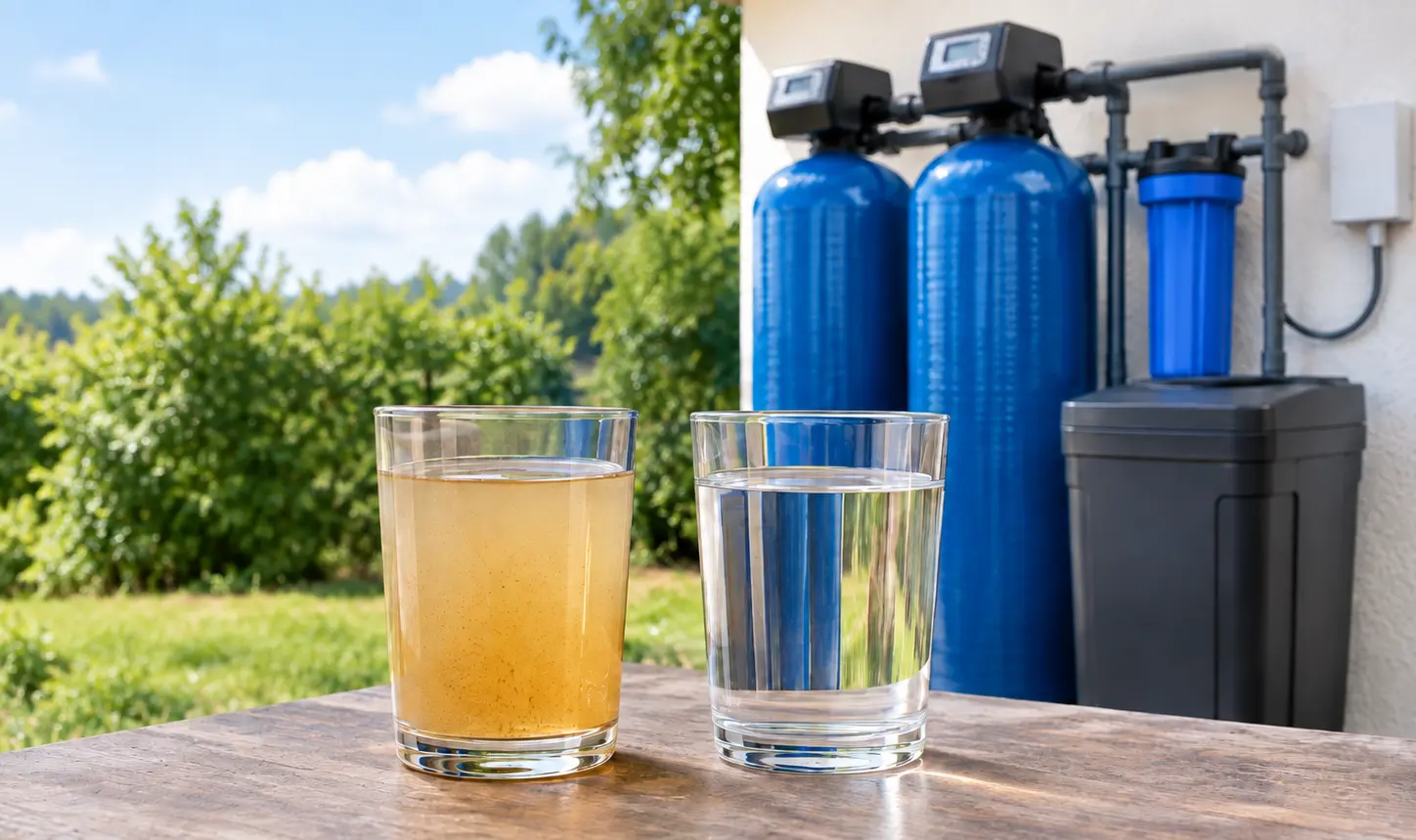
Iron and manganese are among the common problems of groundwater. Well water can be completely clear when pumped, and only after contact with air does it discolor, become cloudy, or form brown or black sediment.
Choosing the appropriate treatment is not enough to know just the concentration of iron or manganese. The outcome is also influenced by their chemical form, the pH of the water, oxidative conditions, other substances in the water, the desired flow rate, and the operation method of the device. Therefore, there is no single filter that would be suitable for every well.
How iron and manganese manifest in water
Iron and manganese are naturally found in rocks and soil, and under certain conditions, they can be released into groundwater.
In an environment with low oxygen content, substances may be present in dissolved forms in the water. The water may not show any problems at first glance.
After contact with air or another oxidizing agent, the situation may change:
- iron can create yellow, orange to brown coloring and deposits,
- Manganese can create dark brown to black particles and coatings,
- deposits can accumulate in pipes, sanitary equipment, and devices,
- The problem may manifest only after some time from the water extraction.
WHO states that dissolved iron can be present in freshly pumped groundwater without visible coloration, while oxidation results in a typical reddish-brown discoloration. With manganese, significantly lower concentrations can also be problematic, as insoluble manganese oxides can form dark deposits.
The appearance of the water alone is therefore not sufficient for reliably determining the content of iron or manganese.
What values apply to drinking water in Slovakia
According to the current regulation of the Ministry of Health of the Slovak Republic No. 91/2023 Coll., the limit value for drinking water is established:
| Indicator | Medzná hodnota |
| Iron | 0,20 mg/l |
| Manganese | 50 µg/l, which is 0.05 mg/l |
In areas where geological conditions lead to naturally elevated concentrations, the regulation allows for the application of a value of 0.50 mg/l for iron and 100 µg/l, or 0.10 mg/l for manganese, under specified conditions, provided that the sensory properties of drinking water are not affected.
These values should not be confused with the universal health boundary. Slovak legal regulations and WHO health recommendations serve different purposes.
Iron and manganese are not the same from a health perspective
For iron, the WHO does not establish a health-based guideline value for drinking water. At concentrations typically encountered in drinking water, the dominant issues are mainly color, taste, sediments, and operational complications.
The situation is different with mango.
The current WHO Guidelines for Drinking-water Quality use a temporary health-based guideline value for total manganese of 0.08 mg/l, or 80 µg/l. WHO designates it as temporary due to the uncertainties involved in its derivation. Special attention is given to infants fed with formula milk.
The Slovak limit value for manganese of 0.05 mg/l is therefore lower than the current temporary guideline value set by the WHO of 0.08 mg/l. However, these are two values created for different purposes and cannot be interpreted as interchangeable limits.
The current version of the WHO Guidelines was released on June 17, 2026.
What to know before choosing a technology
The result of the analysis with the data "iron" and "manganese" is important, but it is often not sufficient for the design of the equipment.
When it comes to well water, it is necessary to assess, depending on the specific situation, primarily:
- the concentration of iron and manganese,
- pH,
- appearance and turbidity of water,
- ammonium ions,
- organic substances or indicators that signal them,
- possible hydrogen sulfide or other odor,
- microbiological quality, if the water is intended for drinking,
- required peak flow,
- daily consumption,
- pressure and performance of the pump,
- existing water treatment.
When dealing with the problem of existing equipment, it is very useful to compare a sample of raw water before the technology and treated water after the technology.
Deciding based solely on one number can lead to a filter that, while theoretically removing iron or manganese, will not work reliably in a specific water.
Basic principle: oxidation and subsequent filtration
A large part of the technologies for removing iron and manganese uses the same basic logic:
dissolved form → oxidation → insoluble form → capture in filter
An oxidizing agent can be, for example, oxygen from the air or a suitably controlled chemical oxidation process.
However, after oxidation, it is not enough to just let the substance react. The resulting solid particles must be effectively removed from the water, and the filtration bed must be capable of regular backwashing.
Why is manganese more demanding than iron
Although iron and manganese are often addressed together, their behavior is not identical.
Oxidation and manganese capture may require more suitable conditions than iron removal. pH, oxidative conditions, the form of manganese, and the properties of the filtration media used play a particularly important role.
The research on the rapid filtration of Fe(II) and Mn(II) shows that the effectiveness depends, among other factors, on pH, input concentration, adsorption properties of the filtration media, and the kinetics of oxidation processes. Higher pH generally increased the adsorption of iron and manganese on the studied media.
Therefore, it is not possible to establish a single universal pH or a single universal filtration medium suitable for every well water.
Aeration and Filtration
In some waters, iron can be oxidized by oxygen from the air. After aeration, filtration of the resulting particles follows.
The advantage is that it is not necessary to automatically add chemical oxidizing agents to the water.
Such a solution must be designed according to:
- input concentration,
- pH,
- available reaction time,
- amounts of oxygen,
- required flow,
- filter capacity,
- the amount of water needed for backwashing.
Aeration alone may not be sufficient for reliable manganese removal.
Catalytic filtration media
Another option is filter media whose surface promotes the oxidation and capture of iron or manganese.
However, their effectiveness cannot be judged solely by the name of the cartridge.
A specific medium may have requirements for:
- minimum or optimal pH,
- dissolved oxygen content,
- permissible concentration of iron and manganese,
- the presence of hydrogen sulfide or organic substances,
- filtration rate,
- backwash speed,
- method of regeneration.
Therefore, the specification "iron and manganese filter" does not mean that the device is suitable for a specific well.
Chemical oxidation may be suitable, but it requires a controlled process
In some waters, oxidizing agents are used, such as chlorate or permanganate. In larger or specific technologies, other oxidation processes may also be utilized.
The advantage may be a faster or better controllable oxidation.
At the same time, it is necessary to correctly determine the dosage, reaction time, subsequent filtration, and method of result control. The consumption of the oxidizing agent is influenced not only by iron and manganese but also by other substances in the water.
Chemical dosing should not be set independently based solely on a general internet guide.
Can iron and manganese remove a softener?
Ion exchange can capture certain dissolved forms of iron or manganese under certain conditions. However, this does not mean that every water softener can be used as an iron removal filter.
The documentation of the specific resin and equipment, the form of iron, its concentration, and the overall composition of the water are crucial.
The problem may primarily be oxidized iron, which can contaminate the resin. Under unsuitable conditions, the capacity and operation of the device may gradually deteriorate.
If the device is to simultaneously address hardness, iron, or manganese, its suitability should be verified according to the specific water and the technical documentation of the used medium.
Reverse osmosis is not a common solution for iron water for the whole house
Reverse osmosis can significantly reduce the amount of many dissolved substances, but the membrane is sensitive to fouling.
If the raw water contains elevated levels of iron, manganese, or already formed particles, appropriate pre-treatment may be necessary before the membrane stage.
In the case of iron and manganese problems in an entire family home, their removal is usually addressed first through an appropriate raw water treatment process, rather than by installing kitchen reverse osmosis as a substitute for central treatment.
Most Common Mistakes in Iron Removal and Manganese Removal
Filter selection based only on iron concentration
Two wells with the same iron content may not require the same technology. The difference may lie in pH, the chemical form of iron, manganese, organic substances, ammonium ions, or hydraulic conditions.
Ignoring manganese
The technology that reliably removes iron may not sufficiently remove manganese under the same conditions.
Flow resolution
The filtration device must handle not only the average daily consumption but also the instantaneous flow of the household. At the same time, there must be sufficient flow available for backwashing the filter.
Insufficient waste
Automatically flushed filtration systems generate wastewater. Therefore, the option for its safe disposal is part of the design.
Selection by title of the content
The same type of problem can be solved using different media. Each has its own operating conditions and limits. Without knowledge of the input water, it is not possible to determine from the filter's name whether the solution will work.
Neglect of outcome control
The installation of the equipment is not proof that the water already meets the required quality.
How to verify that the adjustment works
After putting the device into operation, the result must be verified.
When it comes to iron and manganese, it makes sense to compare the concentrations in the incoming and treated water after the operation has stabilized. Depending on the purpose of the water, additional indicators may also be necessary.
If water is used for drinking, the presence of acceptable levels of iron and manganese alone does not confirm the overall health safety of the water. The scope of analysis must correspond to the water source, the intended use, and potential risks.
WHO emphasizes risk management from the source to the point of consumption when assessing drinking water, rather than evaluating safety based on a single parameter.
What to prepare before the proposal for deironization and demanganization
It is advisable to have for the proposal:
- current analysis of raw water,
- the value of iron and manganese,
- pH and other relevant indicators,
- information about the source and use of the well,
- number of persons and collection points,
- water consumption estimate,
- peak flow or pump data,
- water pressure,
- photograph of the assembly space,
- information about waste and electrical connection.
For the existing device, you need to add its model, age, filter cartridge, and service history.
Key conclusion
Iron and manganese can be effectively removed from well water, but the right technology cannot be chosen based solely on the color of the water or a single number in the analysis.
First, it is necessary to know the composition of the raw water, the pH, the nature of the problem, and the desired flow rate. Only then can one decide whether air oxidation, catalytic filtration, controlled chemical oxidation, ion exchange, or a combination of several steps is appropriate.
The result should be verified by measurement or a control analysis after the device is started.
Danum s.r.o.