When is the use of a water softener justified?
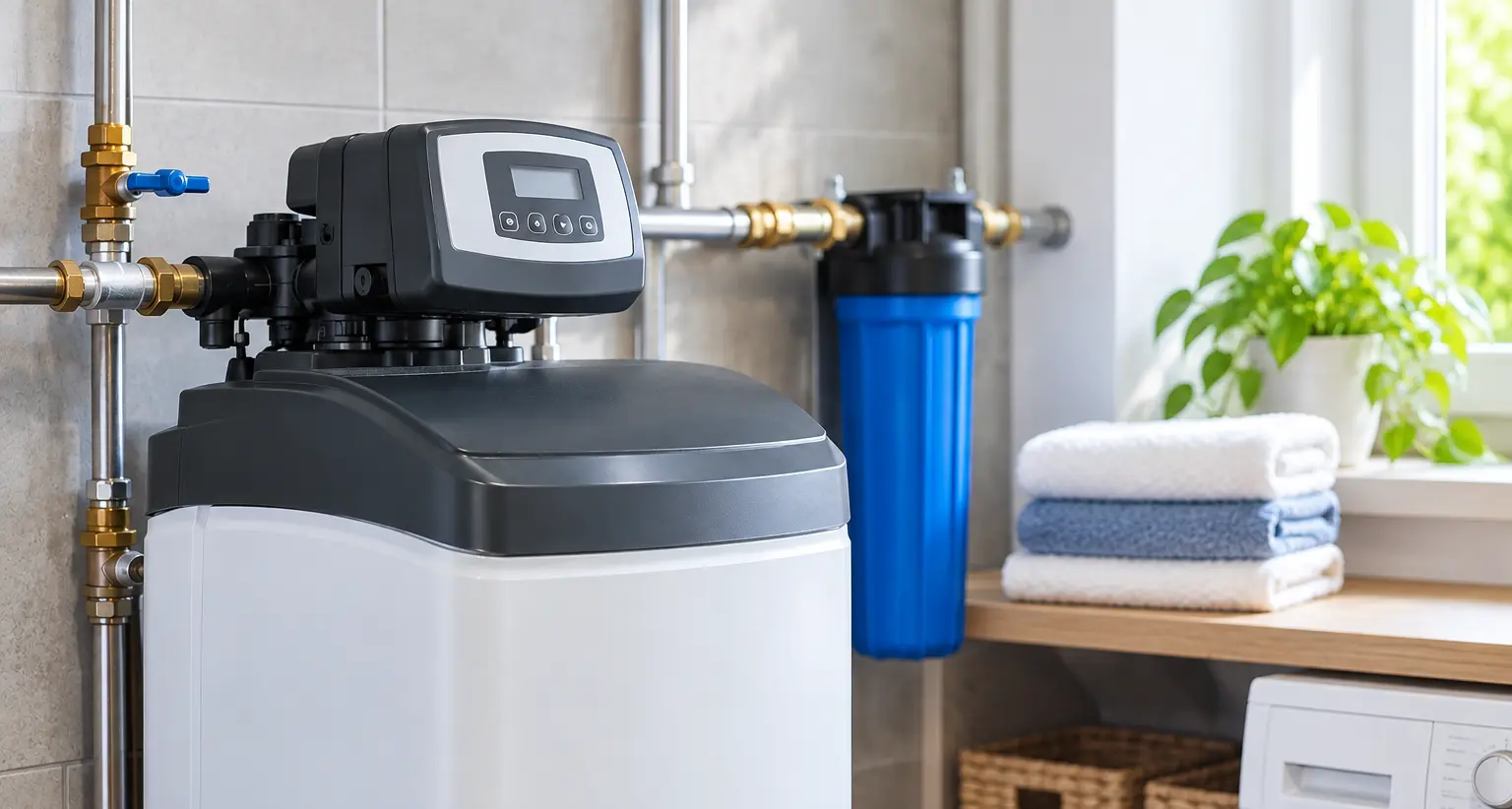
A water softener makes sense primarily when the water is demonstrably hard and the hardness causes a specific problem – for example, significant limescale buildup on heating elements, sanitary surfaces, or in appliances. However, mere white spots or deposits are not enough to choose a specific device.
Before designing a water softener, it is necessary to know at least the source of the water, its hardness, consumption, required flow rate, and installation conditions. For well water, it is also important to check other relevant indicators, as the softener itself is not a universal device for treating well water.
What a water softener actually does
In households, the term softener most commonly refers to a device based on ion exchange. Calcium and magnesium, which make up a significant part of water hardness, are exchanged for other ions when passing through the ion-exchange resin, primarily for sodium in the case of common sodium softeners.
The result is a reduction in water hardness. The softener therefore primarily addresses issues related to hardness and the formation of mineral deposits.
However, it is not correct to understand it as a device that automatically improves all properties of water. Regular softening alone is not a solution, for example, to microbiological contamination, nitrates, or all problems associated with iron, manganese, or odor.
When does softening have practical significance
The most common reason is limescale. When hard water is heated, mineral deposits can form, which can appear, for example:
- on heating elements and in hot water storage tanks,
- in electric kettles and other appliances,
- on shower walls, faucets, and sanitary surfaces,
- on the shelves and in the store,
- in devices sensitive to the formation of deposits.
In hard water, the effectiveness of soaps and cleaning agents is also reduced because some of them react with calcium and magnesium ions. Therefore, after softening, it may be necessary to adjust the dosage of detergents and cleaning agents.
However, this does not mean that central softening is automatically the most economically or technically viable solution for every visible trace of limescale. The intensity of the problem, water consumption, heating method, desired comfort, and operating costs of the equipment are what determine the best approach.
First, determine the actual hardness of the water
Hardness cannot be reliably determined just by the appearance of water. For the design of a softener, it is necessary to know the measured value and the unit in which it is expressed.
Total hardness can be expressed, for example, in:
- mmol/L,
- German degrees °dH,
- mg/l expressed as CaCO₃.
These units describe the same phenomenon in different ways. Therefore, it is not enough to say that water has, for example, "20 degrees," if it is not clear which scale is being referred to.
If you use water from a public water supply, information about its composition may be available from the water supplier. For a private well, it is advisable to rely on a current water analysis.
When it comes to well water, it's not enough to know just the hardness
This is one of the most common mistakes when choosing a device.
Water from a well can be hard and may also contain other substances or exhibit properties that significantly affect the design of treatment. When selecting, it is necessary to check, depending on the specific situation, for example:
- iron and manganese,
- pH,
- ammonium ions,
- cloudiness and mechanical impurities,
- microbiological indicators,
- other chemical parameters relevant to the given source.
The device should not be selected for well water based solely on one number indicating hardness. The internal decision-making methodology of Danum is based on the water source, current analysis, flow rate, consumption, and installation conditions during the design process.
Hardness is not the only information needed to choose a softener
Even two households with the same water hardness may require different equipment.
For the proposal, it is important to know especially:
Water consumption.
It affects the required capacity of the device and the frequency of regeneration.
Peak flow.
The softener must handle immediate demand when multiple withdrawal points are used simultaneously.
Water pressure.
The device creates hydraulic resistance and must operate under conditions specified for the particular model.
Pipe size.
Too small a device or improper connection can restrict flow.
Installation location.
You need to account for space for the equipment, a brine tank, and service access.
Waste and electricity.
The ion-exchange softener needs to drain water to waste during regeneration; most automatic devices also require electrical power.
The selection based solely on the number of household members may therefore be too simplified.
What happens during regeneration
Ion exchange resin has a limited capacity. After a certain amount of treated water, it needs to be regenerated.
In common household water softeners, a saline solution is used for regeneration. During the cycle, the captured calcium and magnesium ions are removed from the resin, restoring its ability to soften more water.
Operations therefore include:
- consumption of regeneration salt,
- certain water consumption during regeneration,
- wastewater,
- regular inspection of the equipment,
- service according to the specific model and operating conditions.
That is why it makes sense to size the softener according to actual consumption and hardness, rather than simply choosing the largest device.
Drinking water after softening requires separate assessment
In sodium ion exchange softening, calcium and magnesium in water are replaced by sodium. The greater the portion of hardness that is removed, the greater the change in sodium concentration can be.
The Slovak Regulation No. 91/2023 Coll. states a limit value of 200 mg/l for sodium in drinking water. It also sets recommended values for calcium and magnesium: for calcium more than 30 mg/l, for magnesium 10 to 30 mg/l, and for the sum of calcium and magnesium expressed as hardness 1.1 to 5.0 mmol/l.
When treating water with calcium or magnesium concentrations higher than the recommended values, the regulation states that in the treated drinking water, calcium concentrations should not drop below 30 mg/l and magnesium below 10 mg/l. This is an important reason why a single universal target hardness value cannot be automatically enforced for all households regarding drinking water.
The recommended value is not the same as the maximum allowable value. The mere failure to meet the recommended value, according to the definition of the regulation, does not automatically exclude the use of water as drinking water.
Complete softening is not a universal goal
A common belief is that the lower the hardness, the better the water. This rule does not apply.
The target hardness depends on:
- purpose of water,
- input composition,
- materials in the distribution systems,
- requirements of appliances or technology,
- whether it is a drinking or just a technological branch,
- method of mixing treated and untreated water.
Corrosivity cannot be assessed solely based on hardness. It is influenced by several properties of water, including pH, alkalinity, dissolved substances, temperature, and the material of the distribution system. Slovak requirements for drinking water also state that drinking water should not have aggressive properties.
Therefore, it is not appropriate to use a single number like "always set to X °dH" without knowledge of the specific water and system.
When a softener is unlikely to provide adequate benefit
Mitigation may not be justified if:
- the hardness is low or moderate and does not create a significant operational problem,
- you are only addressing a local issue of one appliance,
- The cause of the problem is not hardness at all,
- the well lacks a current analysis and it is unclear what all the water contains,
- The goal is to remove substances that a regular softener does not address,
- there are unsuitable conditions for regeneration, waste, or service,
- Operating costs and maintenance are disproportionate in relation to the expected benefits.
It is therefore important not to decide based on the name of the technology, but based on the specific problem.
A water softener and a device against limescale are not automatically the same
On the market, devices that do not chemically reduce water hardness are also sold under the label "softener."
If the technology only changes the behavior of mineral deposits or tries to limit their adhesion, the result may not be truly softened water. The hardness measured before and after the device may remain practically the same.
If the desired outcome is a real reduction in the concentration of ions responsible for hardness, the technology should be selected based on this goal and the demonstrable principle of its operation.
How to make decisions in practice
Before purchasing a water softener, prepare five basic pieces of information:
- Where does the water come from?
Public water supply or private well. - What is its true hardness?
The value must have a specified unit. - What problem do you want to solve?
Hard water, protection of water heating, comfort while showering, a specific technological requirement, or something else. - What is your consumption and required flow rate?
It's not enough just to count the number of household members. - What are the installation conditions?
Space, piping, pressure, electricity, waste, and service options.
If it is well water, please provide the current water analysis. Without it, it is not possible to reliably determine whether the softener itself is a suitable solution.
Key rule
A water softener is justified when it addresses proven water hardness and a specific technical or comfort issue.
However, it is not a universal filter, and its suitability cannot be determined solely by the limescale on the faucet or by the number of people in the household.
First, it is necessary to understand the water and the operating conditions. Only then does it make sense to address the size of the equipment, its settings, and the extent of softening.
Danum s.r.o.